

I Received CP508C and Letter 6152: Now What?

NoticeWhat it isWhat it meansResponseCP508CNotice that the IRS certified seriously delinquent tax debt to the State Department.A passport application or renewal can be delayed or denied, and a current passport may be subject to State Department action.Resolve the certified debt or an erroneous certification promptly.Letter 6152Notice sent before the IRS makes a passport-revocation referral.The IRS is considering asking the State Department to revoke an existing passport.The IRS instructs the taxpayer to call within 21 days from the date of the letter for a U.S. address, or within 60 days if the letter was mailed to an address outside the United States.CP508RNotice that the IRS reversed the certification.The IRS has notified the State Department of the reversal.No response to CP508R is generally required; keep it for your records.
If you need help resolving unpaid federal taxes or protecting an open passport application, Timothy S. Hart Law Group can help. Call 518-213-3445 or 917-382-5142 or use our online contact form.
Key Takeaways
- CP508C: The IRS sends this notice when it certifies seriously delinquent tax debt to the State Department.
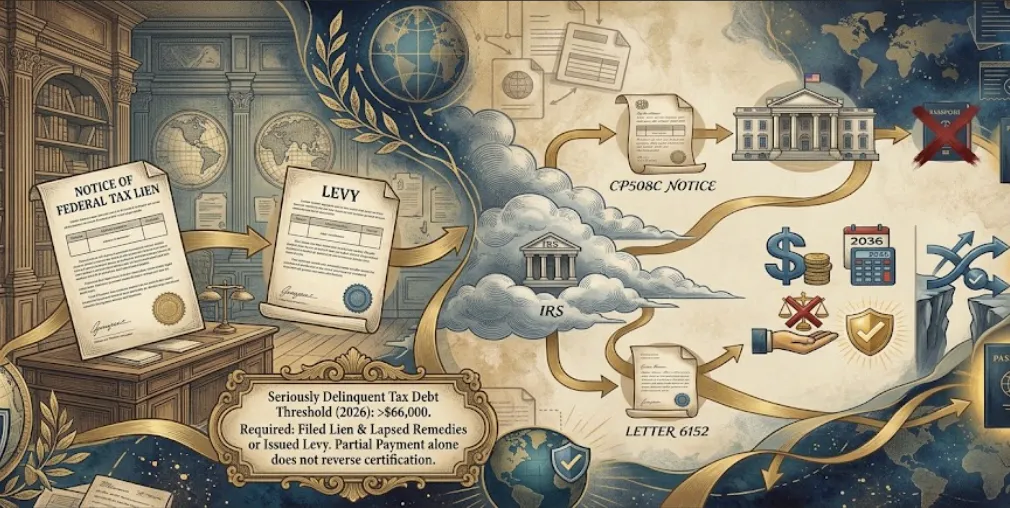
- 2026 threshold: Seriously delinquent tax debt generally means legally enforceable, unpaid federal tax debt totaling more than $66,000, including assessed penalties and interest, after the IRS has filed a Notice of Federal Tax Lien and applicable administrative remedies have lapsed or been exhausted, or the IRS has issued a levy.
- Letter 6152: The IRS sends this letter before making a revocation referral asking the State Department to consider revoking an existing passport. The IRS instructs recipients with a U.S. address to call within 21 days from the date of the letter, or within 60 days if the letter was mailed to an address outside the United States, to resolve the account.
- Reversal: The IRS reverses certification when the certified debt is fully satisfied or becomes legally unenforceable, is no longer seriously delinquent under the applicable rules, or the certification was erroneous. Partial payments that merely reduce the balance below the threshold do not by themselves reverse an existing certification.
- Expedited reversal: The IRS may expedite reversal for a taxpayer with an open or pending passport application who has international travel within 45 days or lives abroad and provides the required documentation.
What Is a CP508C Notice?
A CP508C notice means the IRS has certified your seriously delinquent federal tax debt to the U.S. Department of State. For 2026, the threshold is more than $66,000. The debt must also meet the statutory collection condition: the IRS must have filed a Notice of Federal Tax Lien and the applicable administrative remedies must have lapsed or been exhausted, or the IRS must have issued a levy.
After certification, the State Department generally will not issue or renew a passport and may deny an application or revoke a current passport. The IRS does not itself issue, limit, deny, or revoke passports.
What Debts Are Not Certified?
IRS guidance excludes several categories, including child support, debts being timely paid through an approved installment agreement, debts being timely paid through an accepted offer in compromise, FBAR penalties, qualifying Justice Department settlement agreements, certain debts subject to a timely requested collection due process hearing, and debts suspended because of a request for innocent spouse relief.
Certification Exceptions
The IRS also identifies circumstances in which it will not certify a taxpayer, including certain currently-not-collectible hardship accounts, pending installment-agreement or offer-in-compromise requests, tax-related identity theft, bankruptcy, certain federally declared disaster situations, and an IRS-accepted adjustment that will fully satisfy the debt. Certification is also postponed for qualifying combat-zone or contingency-operation service.
What Is Letter 6152, and How Is It Different from CP508C?
CP508C is sent when the IRS certifies seriously delinquent tax debt to the State Department. Letter 6152 comes later if the IRS is considering a revocation referral concerning an existing passport. Before sending that referral to the State Department, the IRS sends Letter 6152 and asks the taxpayer to call within 21 days from the date of the letter for a U.S. address, or within 60 days if the letter was mailed to an address outside the United States, to resolve the account.
CP508C, Letter 6152, and CP508R Comparison
CP508C
- What it is: Notice that the IRS certified seriously delinquent tax debt to the State Department.
- What it means: A passport application or renewal can be delayed or denied, and a current passport may be subject to State Department action.
- Response: Resolve the certified debt or an erroneous certification promptly.
Letter 6152
- What it is: Notice sent before the IRS makes a passport-revocation referral.
- What it means: The IRS is considering asking the State Department to revoke an existing passport.
- Response: The IRS instructs the taxpayer to call within 21 days from the date of the letter for a U.S. address, or within 60 days if the letter was mailed to an address outside the United States.
CP508R
- What it is: Notice that the IRS reversed the certification.
- What it means: The IRS has notified the State Department of the reversal.
- Response: No response to CP508R is generally required; keep it for your records.
If You Are Applying for a Passport or Renewal
When a person with certified tax debt applies for or renews a passport, the State Department generally holds the application open for 90 days from the date of its letter so the taxpayer can make a satisfactory payment arrangement, fully pay the debt, or resolve an erroneous certification. If the issue is not resolved within that period, the State Department may deny and close the application.
How to Respond to CP508C or Letter 6152
Contact the IRS promptly. Depending on the facts, resolution may include full payment, an approved installment agreement, an accepted offer in compromise, correction of an erroneous certification, or another status that makes the debt no longer seriously delinquent. The exact option depends on the taxpayer’s account and eligibility.
The IRS states that it will reverse certification and notify the State Department within 30 days after the conditions for reversal are met. A partial payment that merely reduces a certified balance below the annual threshold does not by itself reverse certification.
Requesting Expedited Reversal
For the IRS to expedite reversal, the taxpayer must have an open or pending passport application or renewal request. The taxpayer must also have international travel scheduled within 45 days or live abroad and provide the documentation the IRS requires. That documentation includes proof of travel or the time-sensitive need for a passport and a recent State Department letter concerning the passport application or revocation.
When the requirements are met, the IRS says expedited processing can generally shorten the standard 30-day processing period to about 9–16 days.
If You Believe the Certification Is Wrong
If you believe the IRS certified the debt in error, contact the IRS using the information on CP508C and provide supporting records. Federal law also provides judicial review in the U.S. Tax Court or a U.S. District Court for certain certification or reversal disputes.
When to Talk to Timothy S. Hart Law Group
If you are unsure how to resolve certified tax debt, have received Letter 6152, or have an urgent passport application, a tax professional can help evaluate the account and available resolution options. Contact Timothy S. Hart Law Group online or call the Albany office at 518-213-3445 or the New York City office at 917-382-5142.
Frequently Asked Questions
What’s the difference between CP508C and Letter 6152?
CP508C tells you that the IRS has certified seriously delinquent tax debt to the U.S. Department of State. Letter 6152 is sent before the IRS makes a revocation referral asking the State Department to consider revoking an existing passport.
Can the IRS take my passport without warning?
The IRS does not issue or revoke passports. The IRS sends CP508C when it certifies seriously delinquent tax debt to the State Department, and it sends Letter 6152 before making a passport-revocation referral. The State Department has sole authority to issue, limit, deny, or revoke a U.S. passport.
How fast can I get my certification reversed?
After the conditions for reversal are met, the IRS generally notifies the State Department within 30 days. For taxpayers with an open or pending passport application who have qualifying imminent international travel or live abroad, the IRS says expedited processing can generally shorten the process to about 9–16 days when the required documentation is provided.
Will setting up a payment plan or installment agreement stop the passport revocation?
An approved installment agreement that is being paid on time can make certified debt no longer seriously delinquent and can support reversal of the certification. Processing is not immediate, so taxpayers with passport concerns should act promptly.
Can New York State revoke my passport, too?
New York State does not revoke U.S. passports for state tax debt. New York may recommend suspension of a New York driver’s license when a taxpayer has at least $10,000 in qualifying past-due tax debt, subject to statutory exemptions and procedures.
Sources

Attorney Timothy Hart
Timothy S Hart, the founding partner of the tax law firm of Timothy S. Hart Law Group, P.C. is both a New York Tax Lawyer & Certified Public Accountant. His area of expertise includes innovative solutions to solve your Internal Revenue Service and New York State tax problems, including tax settlements through the Federal and New York State offer in compromise programs, filing unfiled tax returns, voluntary disclosures, tax audits, and criminal investigations.